
Beyond Version Control: A Scalable Framework for Clearer Simulation Insights
Keeping pace with simulation and design changes can be difficult in a dynamic development environment. Version control helps manage simulation model development, but it has limitations. Developers often make localized tests and modifications to explore specific scenarios. This can lead to confusion when interpreting results because crucial information is missing:
- Model Version: Which version of the model was used for the test?
- Model Variant: Which variant within the model was active during the simulation?
- Parameter Set: What specific parameters were used in the simulation?
To ensure clear and productive discussions, thorough documentation of the generated simulation results becomes essential. This documentation provides context and facilitates traceability, ensuring everyone is on the same page when referring to the simulation results and the knowledge gained from them.
Additionally, for 1-dimensional simulations, the inherent complexity of the analysis can make the plots generated by developers difficult for non-experts to understand. This is in contrast to 3-dimensional simulations, which often offer more intuitive visualizations. For effective communication and acceptance, developing clear and understandable analysis methods, even for 1-dimensional simulations, becomes crucial.
A unified simulation framework can address these challenges by capturing the entire simulation process. This streamlined workflow ensures all crucial metadata is documented and traceable within each test. In the following sections, we'll explore how to establish and set up this framework for more efficient and transparent simulations.
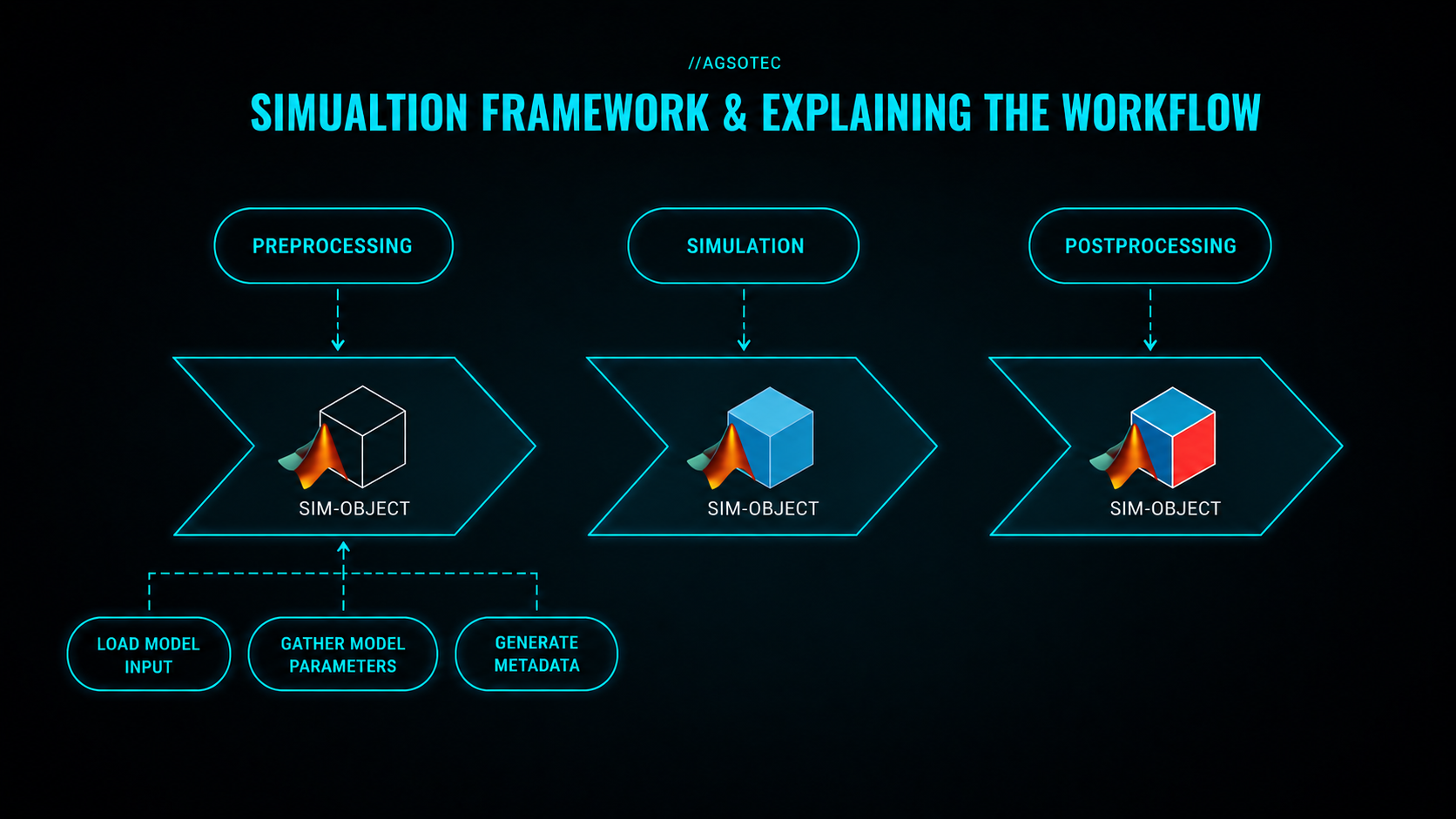
The Simulation Process: A Three-Stage Journey
The simulation process can be visualized as a three-stage journey, with each test run represented by a unique "Sim-Object". This object travels through the following stages:
1. Preprocessing: Gathering the Essentials
Here, the Sim-Object gathers all the necessary ingredients for the simulation. This includes:
- Model Inputs: The data that the simulation model will use.
- Model Parameters: The configurable settings that define the model's behavior.
- Modifications: Any specific changes made to the parameters for this particular run.
By capturing this information, the Sim-Object ensures traceability and repeatability of the simulation.
2. Simulation: The Model in Action
With everything prepared, the Sim-Object enters the simulation stage. Here, the configured model runs, processing the input data and generating results based on the defined parameters.
3. Postprocessing: Analysis and Insights
Finally, the Sim-Object collects the raw results (signals) generated by the simulation. These raw outputs are then analyzed using customized validation criteria, transforming them into meaningful insights.
This three-stage approach ensures a well-defined and documented simulation process, allowing for clear understanding and efficient analysis of the generated results.
Benefits and Conclusion
This automated workflow, powered by the innovative "Sim-Object" concept, transforms simulations into well-organized and efficient processes. Here's how it empowers your work:
- Clear Documentation and Discussions: All relevant information is stored within a standardized Sim-Object. This ensures clear documentation, facilitating communication and understanding of the simulation results and the knowledge they hold.
- Enhanced Traceability: The Sim-Object approach simplifies tracking the origin and context of the results, making traceability a breeze.
- Reproducible Simulations and Effortless Analysis: Verification and further exploration of results become effortless. You can easily reproduce simulations and delve deeper into the data to uncover new insights.
- User-Friendly Sharing and Wider Collaboration: Sim-Objects promote collaboration and wider dissemination of findings. Sharing results is user-friendly, and accessibility extends even to users without specialized licenses.
- Speedup & Scalability: Automation significantly accelerates the entire development process and scaling up simulation can easily be handled by generating campaigns.
Overall, this revolutionary workflow streamlines simulations, fosters transparency, and empowers developers as well as practitioners. They can now make informed decisions based on comprehensive and well-documented simulation data, leading to faster innovation and more impactful results.
Originalbeitrag: agsotec.de
// Kontakt