
Key Takeaways
- Reduce software test execution from days to hours through cloud scalability
- Integrate MATLAB® and Simulink® into an automated CI pipeline using Jenkins and AWS
- Lower infrastructure costs while improving developer feedback cycles and software quality
1. The Challenge
Modern vehicles are increasingly software-defined systems. With every new software release, thousands — or even tens of thousands — of automated tests must be executed before deployment.
As software complexity continues to grow, traditional on-premise testing infrastructures are reaching their limits. Typical challenges include:
- Long regression test execution times
- Limited computing resources
- Expensive hardware investments
- Delayed developer feedback
- Difficult scaling during release phases
For many automotive projects, complete regression tests still require several days. Every software change delays valuable feedback and increases the risk of introducing defects into later development stages.
The challenge is therefore not only executing tests — but executing them fast enough to support modern Continuous Integration workflows.
2. A Cloud-Native Continuous Integration Architecture
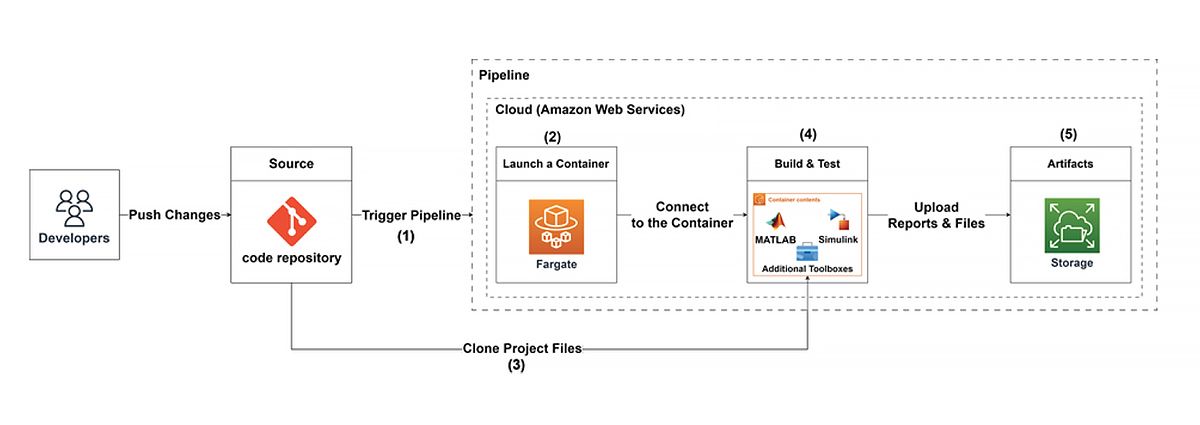
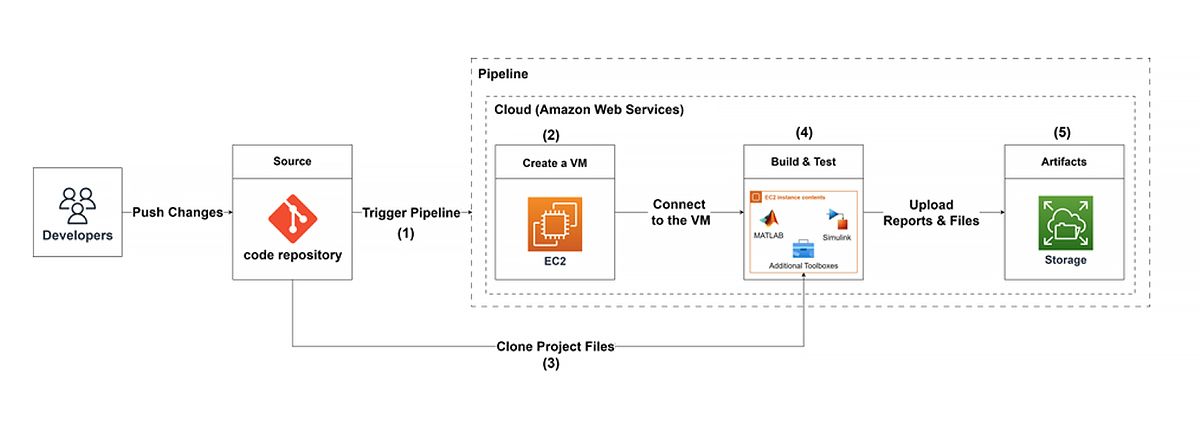
Cloud technologies enable development teams to dynamically scale computing resources whenever they are needed. Instead of maintaining large on-premise infrastructures, virtual machines are provisioned automatically, execute the required test suites and are removed afterwards.
| Component | Purpose |
|---|---|
| Git | Source code management |
| Jenkins | CI orchestration |
| AWS EC2 | Scalable execution environment |
| MATLAB & Simulink | System model |
| TPT | Automated model testing |
| Amazon Machine Images (AMI) | Reproducible test environments |
This setup allows developers to automatically execute regression tests whenever new code is committed.
3. Implementation
Step 1 — Source Code Changes
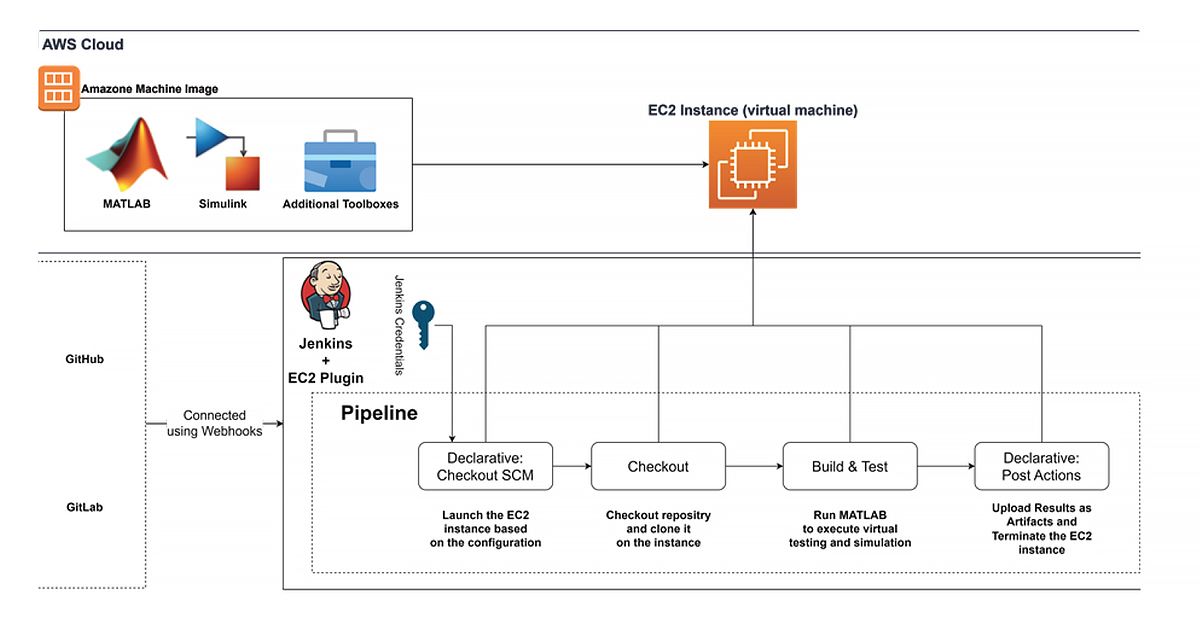
Developers commit changes to the Git repository. A webhook automatically triggers Jenkins.
Step 2 — Dynamic Infrastructure Provisioning
Instead of using permanently running hardware, Jenkins creates the required AWS EC2 instances dynamically. Each instance is initialized from a predefined Amazon Machine Image containing:
- MATLAB
- Simulink
- TPT
- Required dependencies
Because every machine is identical, tests become highly reproducible.
Step 3 — Parallel Test Execution
The regression suite is automatically distributed across multiple virtual machines. Each EC2 instance executes a subset of the test cases independently. Rather than waiting for one workstation to complete all tests sequentially, hundreds of tests can run simultaneously.
Step 4 — Automated Reporting
After execution:
- Jenkins collects all test results.
- JUnit reports are generated automatically.
- Test reports become immediately available to developers.
- Unused cloud instances are terminated automatically.
This minimizes infrastructure costs while keeping compute resources available whenever needed.
4. Security Considerations
When moving testing infrastructures into the cloud, security becomes a critical design aspect. Modern cloud platforms such as AWS provide built-in mechanisms including:
- Identity and Access Management (IAM)
- Virtual Private Clouds (VPC)
- Security Groups
- Audit Logging
- Role-based access control
These services enable secure access while maintaining compliance with corporate security policies.
5. Practical Lessons Learned
What worked surprisingly well
- Jenkins integration with AWS
- Automatic provisioning using Amazon Machine Images
- Parallel execution with TPT
- Highly reproducible environments
Challenges
- Initial cloud configuration
- License management
- VPN integration
- Network permissions
- Managing cloud costs
Despite these challenges, cloud-native CI proved easier to maintain than expanding traditional on-premise infrastructures.
6. Results
Cloud-based Continuous Integration delivers measurable benefits throughout the software development lifecycle.
Faster Feedback
Developers receive regression results significantly earlier. Earlier feedback enables defects to be detected before they propagate into later development stages.
Improved Scalability
Instead of purchasing additional hardware for peak workloads, cloud resources are provisioned on demand. This allows virtually unlimited horizontal scaling.
Lower Infrastructure Costs
Organizations avoid:
- Hardware investments
- Maintenance costs
- Idle computing resources
- Infrastructure upgrades
Instead, they pay only for the resources actually used.
Better Test Quality
Fresh virtual machines eliminate inconsistencies caused by outdated local environments, cached data or manually configured systems. This leads to more reproducible and reliable test results.
Proof of Concept
| On-Premise | Cloud CI |
|---|---|
| Sequential execution | Parallel execution |
| Fixed hardware | Elastic infrastructure |
| Days of testing | Hours (depending on scaling) |
| High upfront investment | Pay-per-use |
7. Conclusion
Cloud-native Continuous Integration fundamentally changes how automotive software testing is performed. By combining MATLAB, Simulink, Jenkins, AWS and TPT into an automated pipeline, development teams can dramatically shorten regression testing cycles while reducing infrastructure costs and improving software quality.
Beyond faster execution times, cloud-based testing establishes the foundation for scalable, reproducible and future-proof software validation. As software complexity in modern vehicles continues to grow, elastic cloud infrastructures will become an increasingly important component of efficient automotive development processes.
Dieser Beitrag ist die Zusammenfassung eines technischen Deep Dives, der gemeinsam mit MathWorks entstanden ist.
Originalbeitrag: agsotec.de
// Kontakt